Thursday, September 28, 2023

Battle of Monmouth - GMT's Battles of the American Revolution

 GMT's Battles of the American Revolution is an operational/grand tactical game series of... you guessed it... various battles of the American Revolutionary War. The graphics and maps are nice, and the rule book is 16 pages.  Specific battle rulebooks are also short, with minimal additional rules.  each battle has a lot of decision-making for both sides, and some mechanics that allow for great replayability.  Below is my playthrough of the Battle of Monmouth, a 14 turn campaign game.  I have Brandywine set up and ready to go now.  


Sorry, the last slide should be game turn 14.  Game end.  

June 16th on Saipan

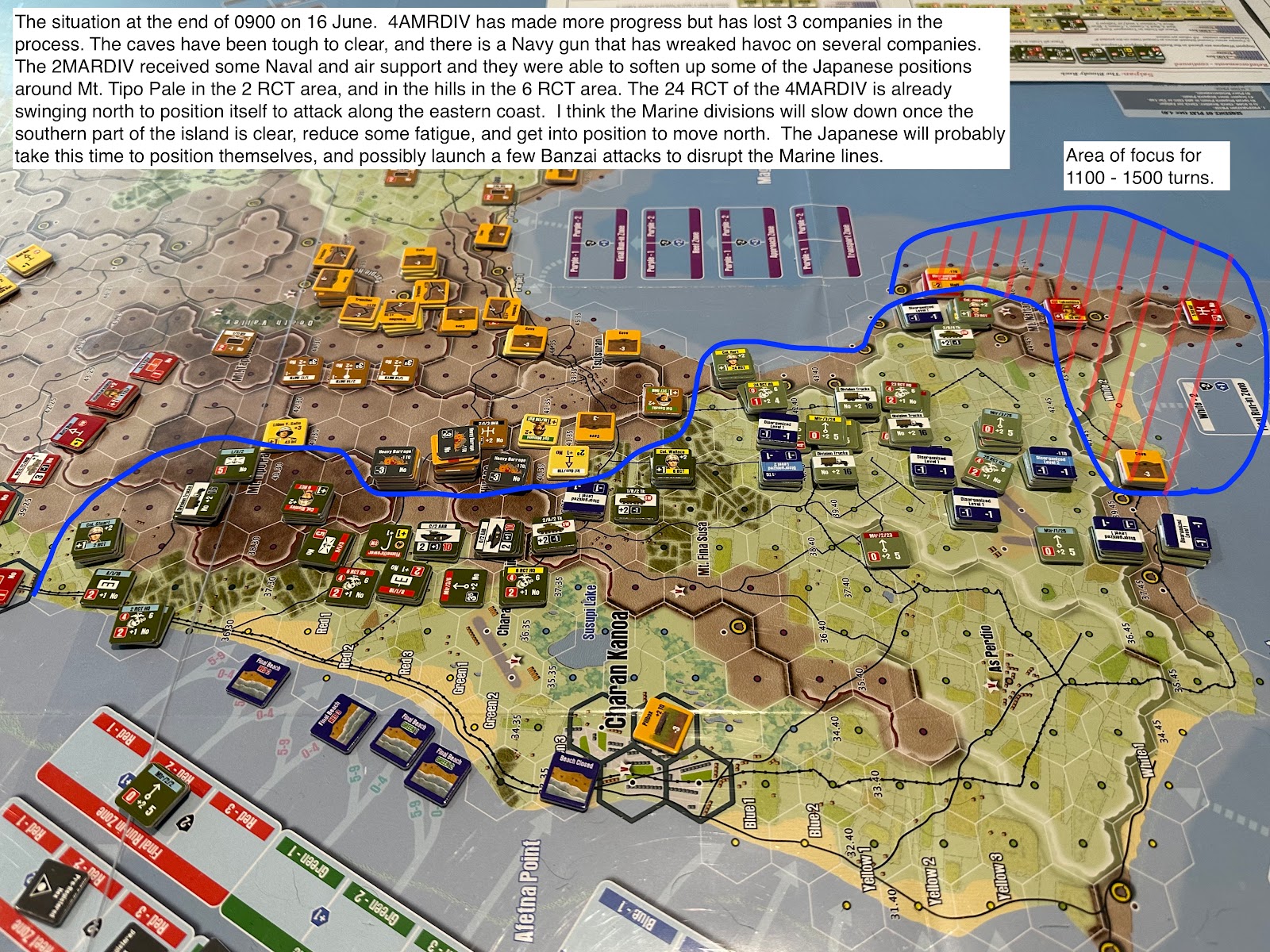
 Below are descriptions of the 0500, 0700, and the 0900 turns of June 16th.  As you can see, the Marines have widened their beachhead, have captured Aslito Airfield, and are in the process of clearing the southern part of the island.  By the end of the day, the southern third of the island should be cleared and the Marin es positioned to push up the island into the mountainous areas.  This will be a tough fight for the Marines as the Japanese are in rocky and rough terrain, dug in, and in caves.  


Tuesday, September 19, 2023

Company Scale System - the Battle for Saipan

 So I have been playing Compass Games' CSS System Saipan: The Bloody Rock.  Adam Starkweather designed this one as well as he MMP Grand Tactical Series, and both are very similar.  Both are awesome designs.  The chit pull system is the heart the game, but how to get the chits in the cup is the blood that flows.  Each division (or brigade sometimes) has a certain amount of dispatch points that are accumulated by a combination of die rolling and dispatch rating.  This rating is the measure of the ability of the division's command and control.  Sometimes you have enough points to do what you want; many times you don't. It's an interesting game system.  And the Marianas Campaign Battles, Guam, Saipan, and Tinian, are very fun to play.  Yes, the Marines will probably win.  But the Japanese have a lot to play with, and can deal some hurt on the Americans.  Here are photos of the progress of Day 1 on Saipan.  Each day has 9 turns, every two hours, from 0700 - 1700 with 2 night turns.  


Now on to day 2!  My plan for the Marines is to take the Aslito Airfield and clean up as much of the south as possible.  The Japanese must continue to fortify their fall back positions in the hills there in front of the 2 MARDIV positions.  This area will see some tough fighting over the next few campaign days.  


Tuesday, October 21, 2014

More Raaco ASL Storage

This is my second installment on my new and improved ASL counter storage using Raaco inserts and Duratool (Raaco clone) storage cases.  Once I decided to use the Raaco storage system, I had to organize it.  This is my engineer side talking here.  I created a diagram of where all of the counters would go, using the Raaco insert layouts.  Here is an example of the Japanese organization:


I created an org chart like this for each of my nationalities.  Some nationalities, like the Japanese, Chinese, Italians, and Allied Minors, consisted of one page, or one layer in the Raaco box.  Other nationalities, like the Americans, Germans, British and Russians filled the whole box, both layers.  Here is the link to the PDF of the entire org chart for all nationalities.

I use a Brother label maker to create labels for all of the inserts.  I like white text on a black label.  here is my American box as an example.  With my Brother label maker, you can connect to a PC and create custom labels with any font and even use graphics.  Note my American box with the Marine insignia.


Below is my entire ASL army in two Duratool Handy Box clones, with 8 storage boxes.  I have one extra on top, which I may use for informational counters or the Finns when they come out!


Monday, October 20, 2014

I Broke Down... Raaco!

Well, I finally broke down and organized my ASL counters with Raaco.  Sort of...  I was able to find Raaco clone boxes by Duratool at MCM Electronics here in the U.S., and purchased Raaco A75 and A78 inserts from CPC Farnell in the UK.  The Duratool clone set of 4 boxes with carrying case (similar to the Raaco Handy Box with 4 cases) was only $30.  Each separate PSC4-01 clone box was only about $6.  The Raaco inserts were fairly inexpensive even when buying them from the UK and shipping them to the U.S.

Here's the Duratool Raaco PSC4-01 clone box.  It looks exactly like the Raaco box, except that it is Black and Yellow.


The Duratool box comes with several Raaco clone inserts that are as deep as the box itself.  They are cheaply made and most of them are warped slightly.  I basically tossed them in a box and am keeping them for my wife for crafts or something.


Another view of the Duratool box.


Below are a few pictures of two of my boxes, one British and one the Japanese/Chinese box.  I'll show some photos now and in another post or two, probably tomorrow and later this week, I'll explain my organization, my labeling technique and post PDF diagrams of my organization.


Here are two pictures of my Japanese/Chinese box.  The Japanese are on top, while the Chinese are in the layer below.


More tomorrow!


Sunday, October 12, 2014

StL Club Historical Magazine on Burma Coming Next Year

Just wanted to let everyone know about the St. Louis ASL Club's first historical magazine coming out next July at our tourney. The first issue is on Burma, 1942, when the Japanese invade. See the flyer below. We are currently playtesting several scenarios on an historical map, and are planning to have 8-10 more scenarios on various map boards (several are also in playtesting). The full color magazine will contain at least 48 pages of articles on various subjects, ranging from an intro to the CBI theater of 1942, Japanese tanks and tank tactics, rice paddies, AAR's/designer notes on the scenarios, and much more stuff. More details to follow! 


Saturday, September 6, 2014

Armor Profile: Japanese Type 92 Tankette

In 1925-29, the Imperial Japanese Army Cavalry School based at Chiba tested several foreign tanks for its needs. The Carden-Lloyd tankettes appeared to be the best suited for their purposes.  The Japanese purchased several of these British tankettes and served as a basis for the first Japanese tankette in 1929.  The production went to Ishikawajima Motorcar Manufacturing Company (now Isuzu). As vehicles were intended for the cavalry corps it couldn't has been classified as a tank but was officially called a “Heavy Armored Car” instead, taking the number 92 in the imperial army ordnance register.

Here's the ASL counter:


The Type 92 was larger than most tankettes of the time, having a one-man turret and a crew of three.  The armament was generally two machine guns. The main gun was a 13.2mm Type 92 heavy machine gun. The weapon had limited traverse, but included a pivoting eyepiece on the gunsight optics and a high-angle mount, allowing anti-aircraft use. Secondary armament was a 6.5 mm Type 91 machine gun, replaced later by the 7.7 mm Type 97 light machine gun mounted in the manually traversed turret. The armor was thin, between 6mm in the hull to 12 mm in the turret.  The thin armor and light armament allowed the weight to be kept to 3 tons.  This proved to be problematic, though, as the armor was not thick enough to be able to withstand any machinegun fire. 

The vehicle underwent several modifications, especially in the drive train and suspension.  An initial variant was designed to be amphibious, but this model was dropped for the early Type 92.  However, the later Type 92 had a significantly improved suspension and wheel configuration, which allowed for better performance. 

Here are a few photos and drawings of the tankette:

This is a photo of the early model with two light machine guns.  


This is a drawing of the late model with the 13.2mm MG in the bow and the improved suspension.


A drawing of the early model with the 13.2mm MG in the bow.